 Urdulik
 › English Poetry › “Hope” is the thing with feathers
Emily Dickinson · 1891
“Hope” is the thing with feathers
The full text of Emily Dickinson’s poem, what it means in plain words, and its best lines as pictures you can download and share.
- Poet
- Emily Dickinson
- Published
- 1891
- First line
- “Hope” is the thing with feathers
“Hope” is the thing with feathers
Emily Dickinson
“Hope” is the thing with feathers -
That perches in the soul -
And sings the tune without the words -
And never stops - at all -
And sweetest - in the Gale - is heard -
And sore must be the storm -
That could abash the little Bird
That kept so many warm -
I’ve heard it in the chillest land -
And on the strangest Sea -
Yet - never - in Extremity,
It asked a crumb - of me.
Best lines
Download lines from “Hope” is the thing with feathers
Press Download JPG for a picture ready for WhatsApp, Instagram or Facebook.
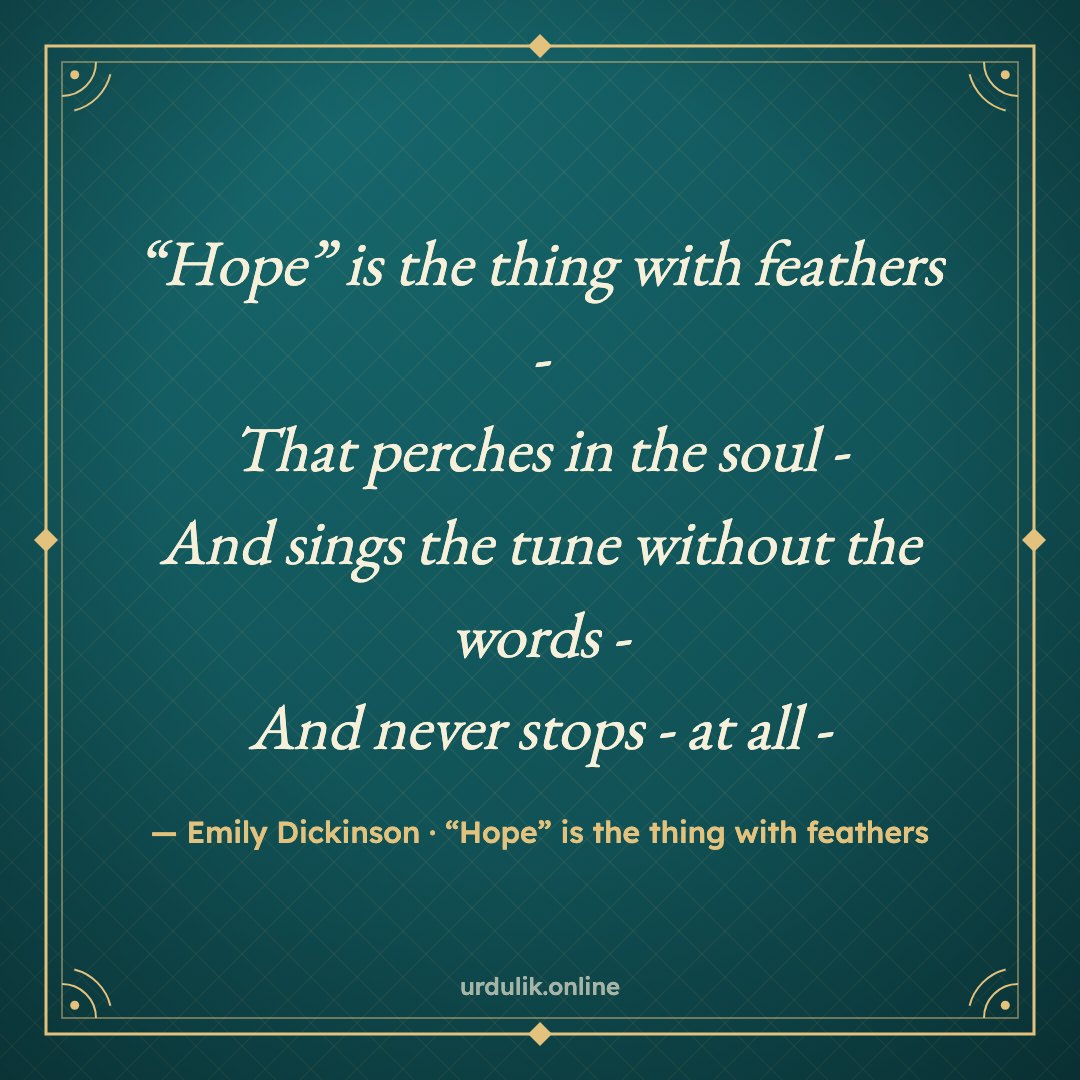
“Hope” is the thing with feathers -
That perches in the soul -
And sings the tune without the words -
And never stops - at all -
Meaning and summary
Dickinson pictures hope as a small bird living in the soul. It sings without words and never stops. Its song is sweetest in a storm, and only a terrible storm could silence the bird that has kept so many people warm.
The speaker has heard it in the coldest lands and strangest seas, yet even in the worst times it has never asked anything in return. Hope, in the poem, is a gift that asks nothing and keeps us going.
Form
Three four-line stanzas in common metre, with Dickinson’s typical dashes and capitals and slant rhymes.
About the poet
Emily Dickinson (1830–1886) of Amherst, Massachusetts, wrote nearly 1,800 poems, almost all published after her death. This one was written around 1861 and first printed in 1891.
Poems
More classic poems
Questions
About the poem
What is hope compared to in the poem?
To a small bird that perches in the soul and sings without stopping.
What does “it asked a crumb of me” mean?
That hope never asked anything in return, even in the hardest times.
Why does Dickinson use so many dashes?
They are her way of pausing and stressing words; her poems were printed this way only later.