 Urdulik
 › English Poetry › Stopping by Woods on a Snowy Evening
Robert Frost · 1923
Stopping by Woods on a Snowy Evening
The full text of Robert Frost’s poem, what it means in plain words, and its best lines as pictures you can download and share.
- Poet
- Robert Frost
- Published
- 1923
- First line
- Whose woods these are I think I know.
Stopping by Woods on a Snowy Evening
Robert Frost
Whose woods these are I think I know.
His house is in the village though;
He will not see me stopping here
To watch his woods fill up with snow.
My little horse must think it queer
To stop without a farmhouse near
Between the woods and frozen lake
The darkest evening of the year.
He gives his harness bells a shake
To ask if there is some mistake.
The only other sound’s the sweep
Of easy wind and downy flake.
The woods are lovely, dark and deep,
But I have promises to keep,
And miles to go before I sleep,
And miles to go before I sleep.
Best lines
Download lines from Stopping by Woods on a Snowy Evening
Press Download JPG for a picture ready for WhatsApp, Instagram or Facebook.
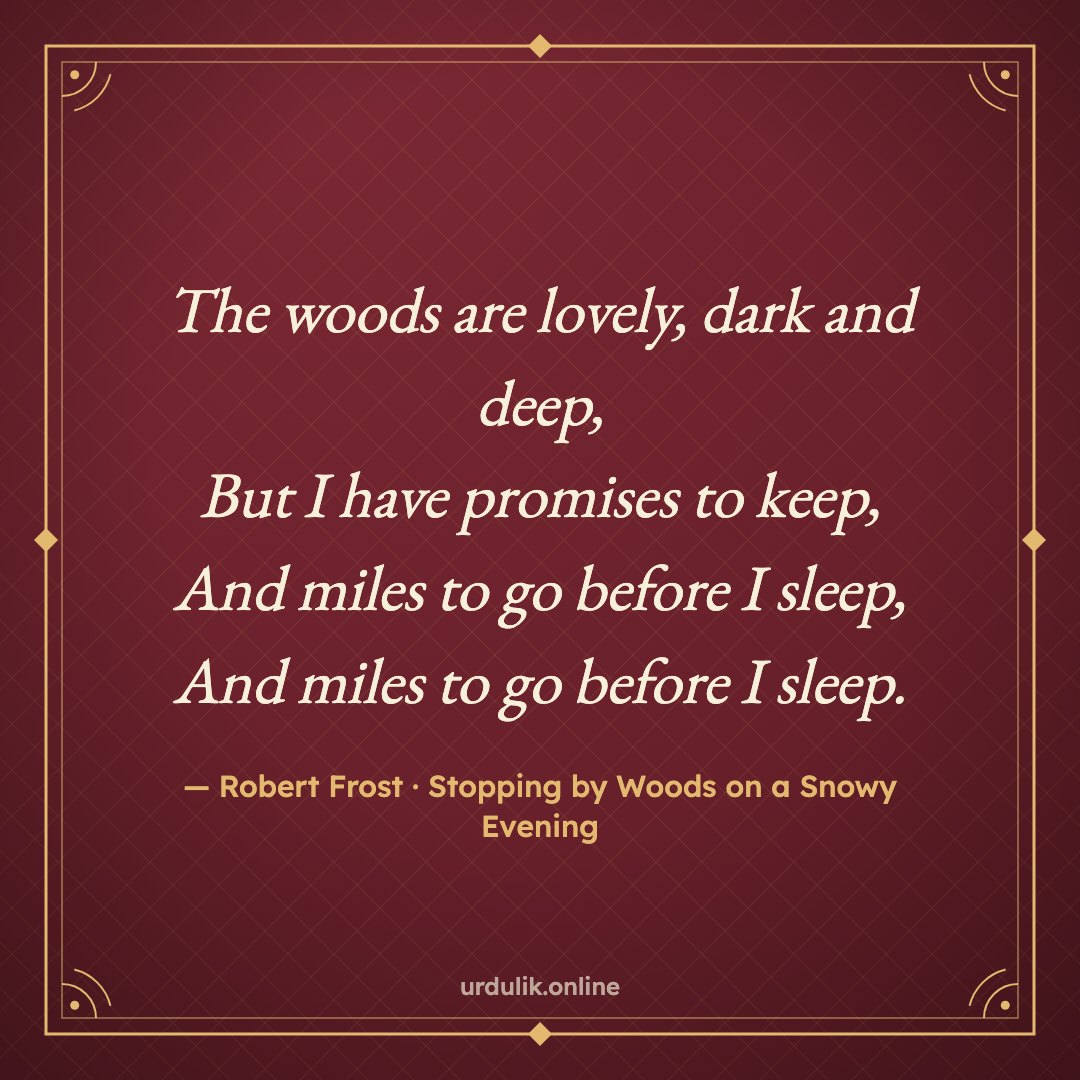
The woods are lovely, dark and deep,
But I have promises to keep,
And miles to go before I sleep,
And miles to go before I sleep.
Meaning and summary
A traveller stops his horse at night beside a wood filling with snow, on the darkest evening of the year. Everything is still; the only sounds are the horse’s bells and the soft wind. He is drawn to the quiet beauty of the woods and wants to stay.
But he remembers his duties: “promises to keep, and miles to go before I sleep”. The repeated last line turns the journey into life itself, and sleep into rest at its end. Jawaharlal Nehru kept these lines on his desk.
Form
Four stanzas of four lines in iambic tetrameter, rhyming AABA BBCB CCDC DDDD: the odd line of each stanza sets the rhyme of the next, and the last stanza closes the chain.
About the poet
Robert Frost (1874–1963) wrote it in 1922; it appeared in his collection New Hampshire (1923), which won the Pulitzer Prize.
Poems
More classic poems
Questions
About the poem
What does “miles to go before I sleep” mean?
That the traveller still has duties to fulfil before he can rest; read deeper, that there is much life to live before death.
Why is the last line repeated?
The repetition slows the poem down and lifts the line from a plain fact about the journey to a thought about life.
What is the rhyme scheme?
AABA BBCB CCDC DDDD.