 Urdulik
 › English Poetry › Sonnet 116
William Shakespeare · 1609
Sonnet 116
The full text of William Shakespeare’s poem, what it means in plain words, and its best lines as pictures you can download and share.
- Poet
- William Shakespeare
- Published
- 1609
- First line
- Let me not to the marriage of true minds
Sonnet 116
William Shakespeare
Let me not to the marriage of true minds
Admit impediments. Love is not love
Which alters when it alteration finds,
Or bends with the remover to remove:
O no! it is an ever-fixed mark
That looks on tempests and is never shaken;
It is the star to every wandering bark,
Whose worth’s unknown, although his height be taken.
Love’s not Time’s fool, though rosy lips and cheeks
Within his bending sickle’s compass come;
Love alters not with his brief hours and weeks,
But bears it out even to the edge of doom.
If this be error and upon me proved,
I never writ, nor no man ever loved.
Best lines
Download lines from Sonnet 116
Press Download JPG for a picture ready for WhatsApp, Instagram or Facebook.
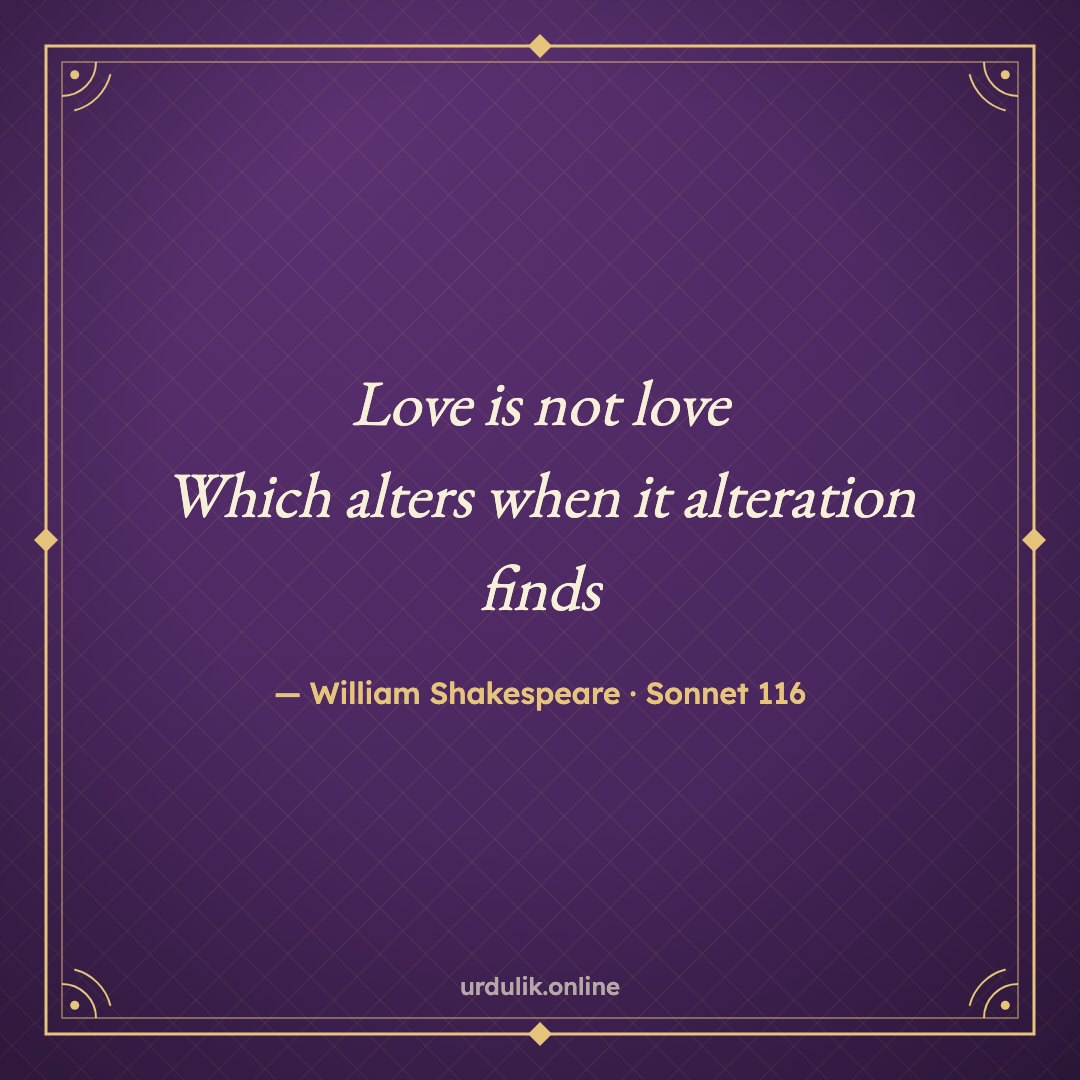
Love is not love
Which alters when it alteration finds
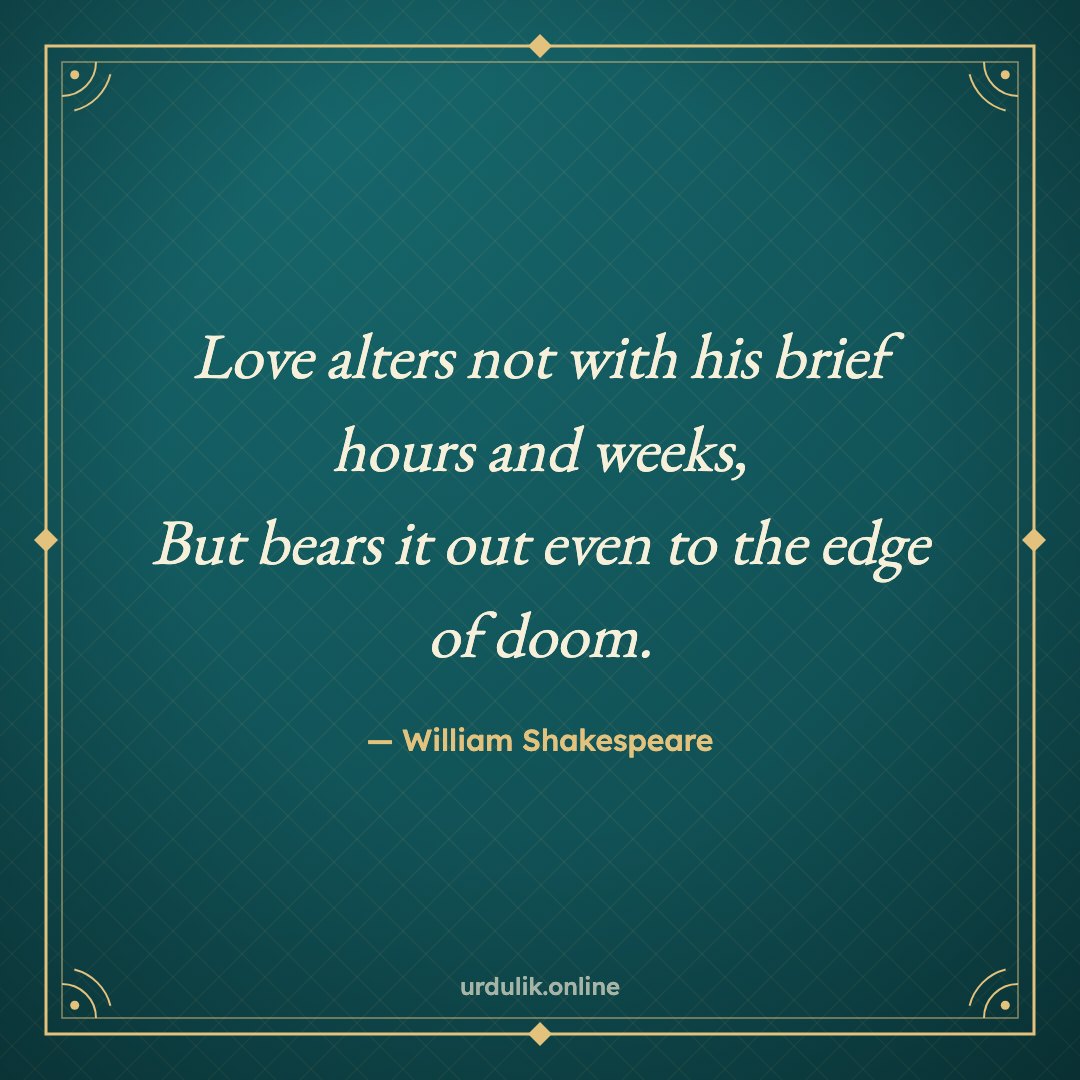
Love alters not with his brief hours and weeks,
But bears it out even to the edge of doom.
Meaning and summary
The sonnet defines true love by what it is not. Love that changes when circumstances change, or fades when the other person leaves, is not love at all. True love is a fixed lighthouse that storms can’t shake, the star that guides every lost ship.
Time may take away youth and beauty, but love does not change with the passing hours; it lasts to the end of life. The poet stakes everything on it: if he is wrong, then he never wrote anything, and no one ever loved. It is often read at weddings.
Form
A Shakespearean sonnet: three quatrains and a couplet in iambic pentameter, rhyming ABAB CDCD EFEF GG.
About the poet
William Shakespeare (1564–1616) published his 154 sonnets in 1609. Sonnet 116 is among the most famous, with Sonnet 18.
Poems
More classic poems
Questions
About the poem
What is Sonnet 116 about?
The nature of true love, which never changes with time or circumstance.
What is “an ever-fixed mark”?
A lighthouse or sea-mark: something fixed that guides ships through storms.
Why is Sonnet 116 read at weddings?
Because it opens with “the marriage of true minds” and describes love that lasts a lifetime.