 Urdulik
 › English Poetry › Sonnet 18
William Shakespeare · 1609
Sonnet 18
The full text of William Shakespeare’s poem, what it means in plain words, and its best lines as pictures you can download and share.
- Poet
- William Shakespeare
- Published
- 1609
- First line
- Shall I compare thee to a summer’s day?
Sonnet 18
William Shakespeare
Shall I compare thee to a summer’s day?
Thou art more lovely and more temperate:
Rough winds do shake the darling buds of May,
And summer’s lease hath all too short a date;
Sometime too hot the eye of heaven shines,
And often is his gold complexion dimm’d;
And every fair from fair sometime declines,
By chance or nature’s changing course untrimm’d;
But thy eternal summer shall not fade,
Nor lose possession of that fair thou ow’st;
Nor shall Death brag thou wander’st in his shade,
When in eternal lines to time thou grow’st:
So long as men can breathe or eyes can see,
So long lives this, and this gives life to thee.
Best lines
Download lines from Sonnet 18
Press Download JPG for a picture ready for WhatsApp, Instagram or Facebook.
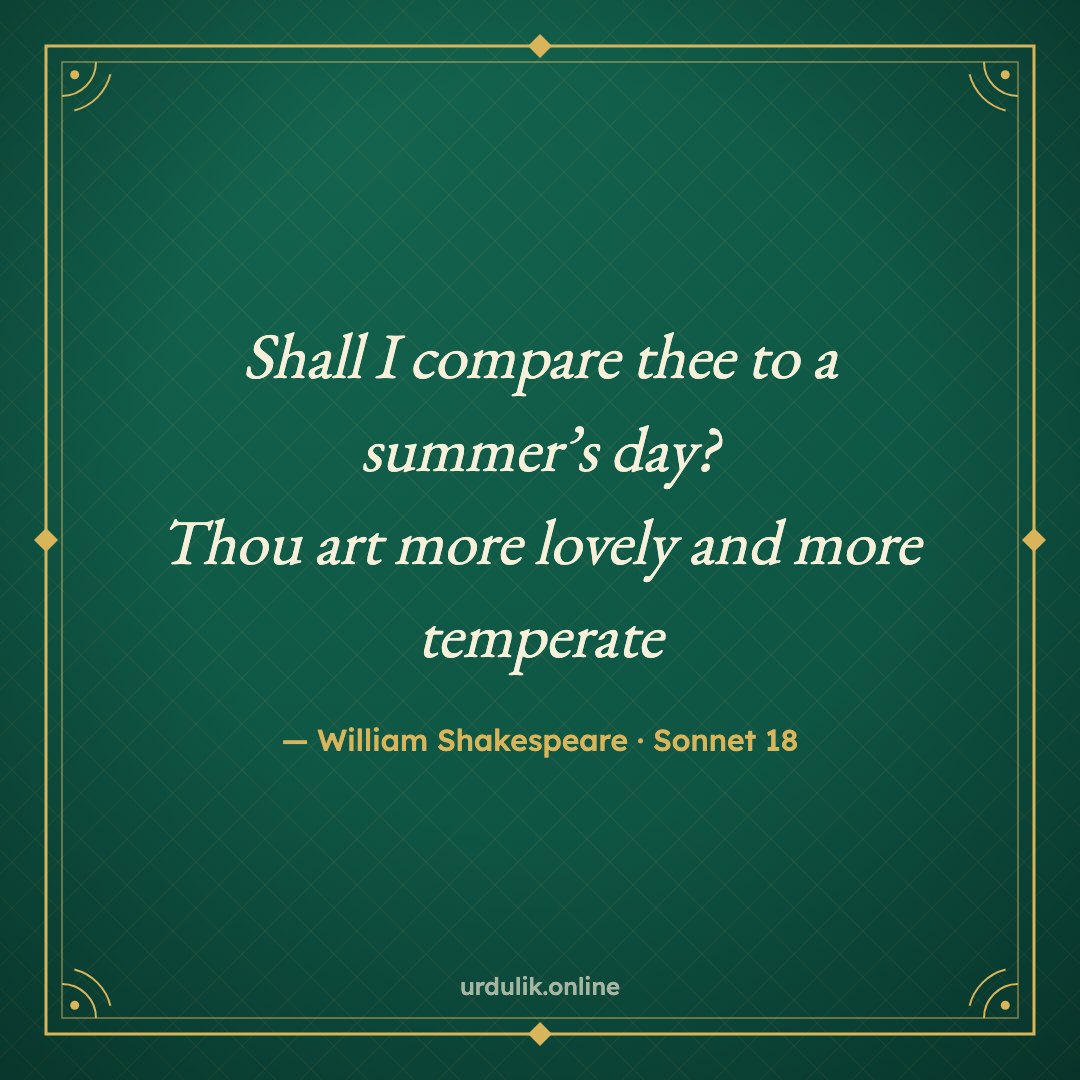
Shall I compare thee to a summer’s day?
Thou art more lovely and more temperate

So long as men can breathe or eyes can see,
So long lives this, and this gives life to thee.
Meaning and summary
The speaker asks whether he should compare the one he loves to a summer’s day, and decides the comparison falls short. Summer is too short, too hot, too windy, and every beautiful thing fades in time. His beloved’s beauty, he says, will not fade, because it lives in the poem itself: as long as people read these lines, the beloved lives on.
So the poem is about two things at once: love, and the power of poetry to defeat time. Its closing couplet is one of the most quoted lines in English.
Form
A Shakespearean sonnet: fourteen lines of iambic pentameter, three quatrains and a closing couplet, rhyming ABAB CDCD EFEF GG. The turn comes at line 9 with “But”.
About the poet
William Shakespeare (1564–1616), the English playwright and poet, wrote 154 sonnets, published together in 1609. Sonnet 18 is the most famous of them.
Poems
More classic poems
Questions
About the poem
What is the meaning of Sonnet 18?
That the beloved is lovelier than a summer’s day, and that their beauty will never fade because the poem keeps it alive.
Who is Sonnet 18 addressed to?
To the “Fair Youth”, a young man to whom the first 126 sonnets are addressed; his identity is unknown.
What is the rhyme scheme of Sonnet 18?
ABAB CDCD EFEF GG.